Cracking the Code: Mastering investment Banking Networking Questions
Networking is the lifeblood of landing a coveted investment banking role. It’s not just about collecting business cards; it’s about building genuine connections, demonstrating your interest, and showcasing your skills. Acing the informational interview is crucial, and that means being prepared for the questions they’ll throw your way, as well as having insightful questions of your own. This comprehensive guide dives deep into the types of questions you’ll encounter, offering strategies and sample answers to help you navigate these conversations with confidence.
I. The “Tell Me About Yourself” Variations
This seemingly simple question is your first chance to make a strong impression. It’s not an invitation to recite your entire life story. Instead, focus on a concise and compelling narrative that highlights your relevant skills and experiences, and demonstrates your passion for finance.
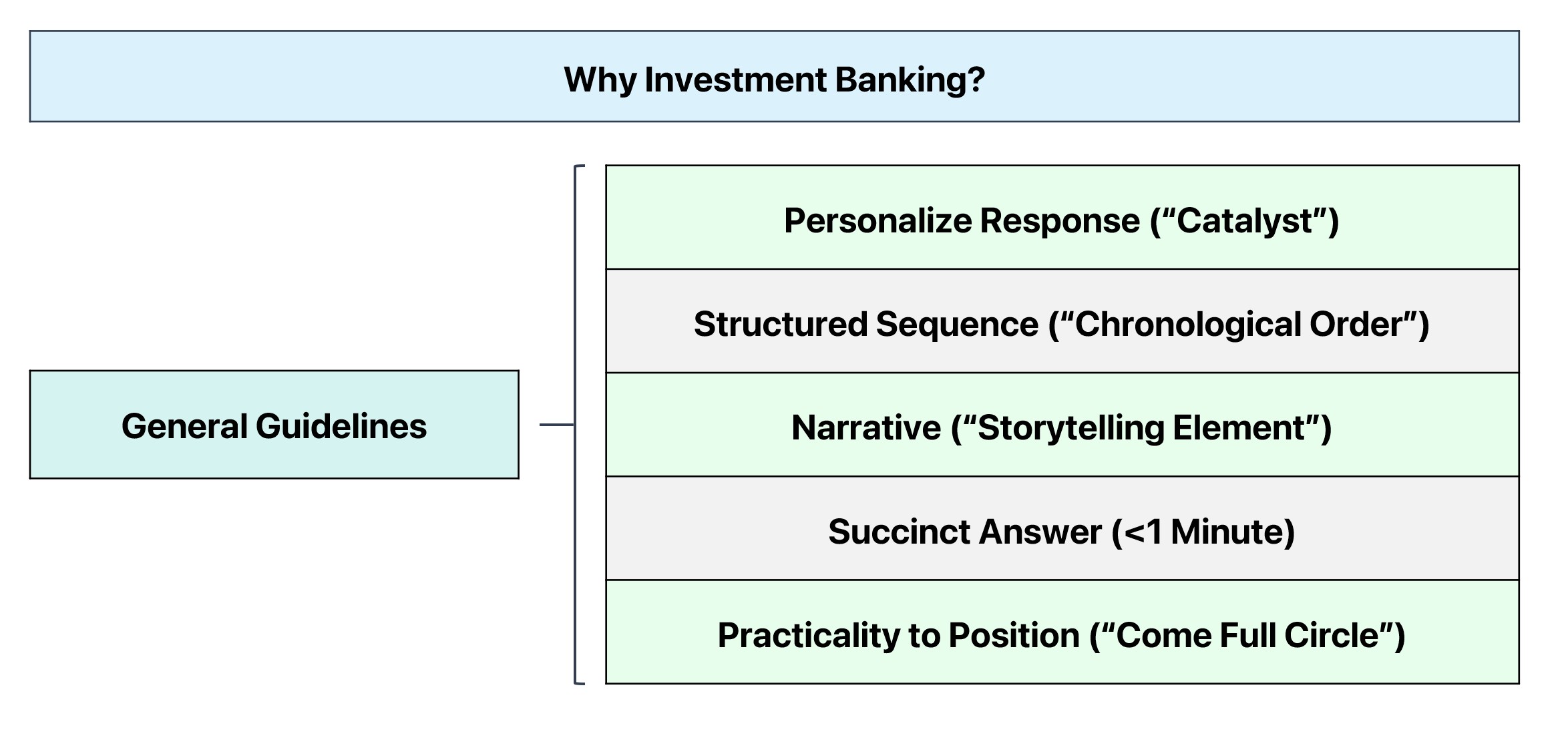
Why Investment Banking? Interview Question
# 1. “Walk me through your resume.”
This is a request for a structured summary of your background. Focus on the experiences most relevant to investment banking, quantifying your achievements whenever possible.
Example: “Certainly. I’m currently a junior at [University] studying [Major] with a minor in [Minor]. My interest in finance began with [brief anecdote]. Since then, I’ve actively pursued opportunities to develop my skills. For example, I served as the Treasurer of the [Club], where I managed a budget of [amount] and increased membership by [percentage]. Last summer, I interned at [Company] in [Role], where I gained exposure to [specific tasks/skills]. I’m particularly drawn to investment banking because of [reasons], and I’m eager to learn more about [specific area of interest].”
# 2. “Why are you interested in investment banking?”
Investment Banking Job Interview Street Of Walls
This is your opportunity to demonstrate genuine interest and understanding of the industry. Avoid generic answers. Instead, connect your skills and interests to the specific demands of the role.
Example: “I’m drawn to investment banking for several reasons. Firstly, I thrive in fast-paced, challenging environments, and I understand that investment banking demands that. Secondly, I enjoy problem-solving and analytical thinking, which are crucial for deal structuring and financial modeling. Finally, I’m fascinated by the impact that investment banking has on businesses and the global economy. I’m particularly interested in [specific area, e.g., M&A, leveraged finance] because [reasons].”
# 3. “Why our firm?”
Research is key here. Demonstrate that you understand the firm’s culture, values, and recent deals.
Example: “I’m particularly interested in [Firm Name] because of your strong reputation in [specific area]. I was particularly impressed by your work on the [recent deal], which showcased your expertise in [specific skill]. I also appreciate the firm’s commitment to [values, e.g., mentorship, diversity]. From speaking with [contact person], I learned about [specific aspect of the firm’s culture], which resonates with me.”
II. Behavioral Questions: Demonstrating Your Skills
These questions explore how you’ve handled past situations, giving the interviewer insights into your skills and character. Use the STAR method (Situation, Task, Action, Result) to structure your answers.
# 1. “Tell me about a time you worked on a team.”
Focus on your contributions and how you overcame challenges.
Example: “In my [Club/Project], we were tasked with [task]. We faced a challenge when [problem]. To address this, I [action]. As a result, we [positive outcome].”
# 2. “Tell me about a time you failed.”
Be honest and reflective. Focus on what you learned from the experience.
Example: “During [situation], I [action] which resulted in [negative outcome]. This taught me the importance of [lesson learned]. Since then, I’ve applied this lesson by [example].”
# 3. “Tell me about a time you had to deal with a difficult client/team member.”
Showcase your communication and conflict-resolution skills.
Example: “In my [experience], I encountered a situation where [problem]. I addressed this by [action, e.g., active listening, clear communication]. Ultimately, we were able to [positive outcome].”
# 4. “Tell me about a time you had to work under pressure.”
Investment banking is demanding. Demonstrate your ability to handle stress.
Example: “During [situation], we faced a tight deadline. To manage this, I [actions, e.g., prioritized tasks, delegated responsibilities]. Despite the pressure, we were able to [positive outcome].”
III. Technical Questions: Assessing Your Financial Acumen
These questions gauge your understanding of finance concepts. Be prepared to explain key terms and demonstrate your analytical skills.
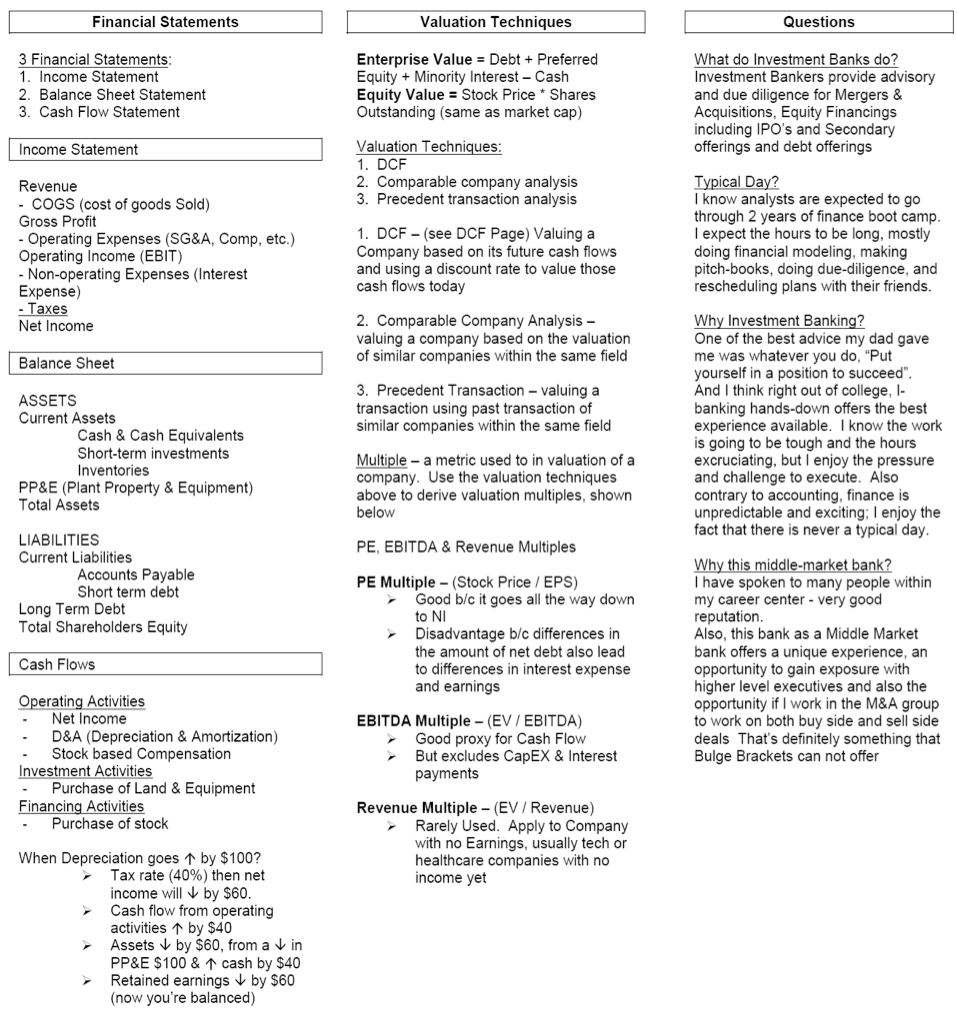
# 1. “Walk me through the three financial statements.”
Demonstrate your understanding of how the statements are interconnected.
Example: “The three main financial statements are the income statement, the balance sheet, and the cash flow statement. The income statement shows a company’s revenues, expenses, and profits over a period of time. The balance sheet shows a company’s assets, liabilities, and equity at a specific point in time. The cash flow statement tracks the movement of cash both into and out of the company during a given period.”
# 2. “What is DCF analysis?”
Explain the concept and its importance in valuation.
Example: “A Discounted Cash Flow (DCF) analysis is a valuation method that estimates the value of an investment based on its expected future cash flows. It involves projecting future free cash flows and discounting them back to their present value using a discount rate that reflects the risk of the investment.”
# 3. “What are some common valuation multiples?”
Be familiar with different multiples and their applications.
Example: “Common valuation multiples include Price-to-Earnings (P/E), Enterprise Value-to-EBITDA (EV/EBITDA), and Price-to-Sales (P/S). These multiples compare a company’s valuation to its financial metrics, allowing for relative valuation against comparable companies.”
# 4. “Explain the concept of leverage.”
Demonstrate your understanding of how leverage impacts a company’s financial position.
Example: “Leverage refers to the use of debt to finance a company’s assets. While leverage can amplify returns, it also increases financial risk. Key metrics for assessing leverage include the debt-to-equity ratio and the debt-to-assets ratio.”
IV. Your Questions: Showing Your Engagement
Asking thoughtful questions demonstrates your genuine interest and intellectual curiosity. Avoid asking questions that can be easily answered through research.
# 1. Questions about the firm:
“I’m impressed by your recent work on [deal]. Can you tell me more about the challenges and opportunities involved?”
“How would you describe the firm’s culture and its approach to mentorship?”
“What are some of the key trends you see shaping the future of [industry]?”
# 2. Questions about the role:
“What are the day-to-day responsibilities of an analyst at your firm?”
“What opportunities are there for professional development and advancement?”
“What skills are most critical for success in this role?”
# 3. Questions about the interviewer’s experience:
“What has been your most rewarding experience in investment banking?”
“What advice would you give to someone starting their career in this field?”
“What are some of the biggest challenges you’ve faced in your career, and how did you overcome them?”
V. The Closing: Leaving a Lasting Impression
Express your gratitude for their time and reiterate your interest in the role.
Example: “Thank you so much for your time and insights. I truly enjoyed learning more about [Firm Name] and this opportunity. My conversation today has further solidified my interest in investment banking, and I’m particularly excited about the prospect of working at your firm. I look forward to hearing from you soon.”
VI. Beyond the Interview: Following Up
Send a thank-you email within 24 hours, reiterating your interest and referencing something specific from your conversation. This small gesture can make a big difference.
By preparing thoroughly for these common investment banking networking questions, you can confidently navigate informational interviews, build meaningful connections, and significantly increase your chances of landing your dream role. Remember, it’s not just about having the right answers, but also about demonstrating your passion, your skills, and your genuine interest in the industry. Good luck!



:max_bytes(150000):strip_icc()/sweepaccount.asp-Final-e0b16e87c6be4879a9376eec7787c292.png?resize=200,135&ssl=1 "Lincoln Investment Sweep Program: An Overview")
